

Àpèjúwe
MountDev AI MCP Connector is a WordPress MCP plugin that lets you connect ChatGPT, Claude, and other MCP-compatible AI clients directly to your WordPress site. Use it to give AI agents secure, controlled access to WordPress posts, pages, media, comments, users, and other site resources through the Model Context Protocol.
If you are searching for a way to connect ChatGPT to WordPress, connect Claude to WordPress, or run AI agents on WordPress with secure authentication and permission controls, this plugin provides a practical WordPress AI connector for content management, publishing workflows, media handling, and site updates.
Built for agencies, developers, publishers, and teams using AI to manage WordPress, MountDev AI MCP Connector supports OAuth 2.0 for ChatGPT, WordPress Application Passwords for Claude Desktop, Cursor, and Windsurf, and profile-based access controls to help keep WordPress automation secure.
Features
- MCP Server Implementation Ìtumọ̀ Yorùbá: – Full JSON-RPC 2.0 endpoint for MCP protocol
- OAuth 2.0 Support Ìtumọ̀ Yorùbá: – Native OAuth authentication for ChatGPT with secure credential generation
- WordPress Application Passwords Ìtumọ̀ Yorùbá: – Secure Basic Auth for Claude Desktop, Cursor, Windsurf
- Profile-Based Access Control Ìtumọ̀ Yorùbá: – Predefined profiles for flexible tool management
- 75+ Essential Tools Ìtumọ̀ Yorùbá: – Posts, pages, media, comments, users, and more
- Zero External Dependencies Ìtumọ̀ Yorùbá: – Pure WordPress implementation
- AES-256-CBC Encryption Ìtumọ̀ Yorùbá: – Client secrets stored securely
Supported Clients
- ChatGPT Ìtumọ̀ Yorùbá: – OAuth 2.0 authentication with Client ID/Secret
- Claude Desktop Ìtumọ̀ Yorùbá: – Basic Auth with Application Passwords
- Cursor Ìtumọ̀ Yorùbá: – Basic Auth with Application Passwords
- Windsurf Ìtumọ̀ Yorùbá: – Basic Auth with Application Passwords
- Any MCP-compatible client supporting OAuth 2.0 or Basic Auth
Available Tools
This plugin provides 75+ WordPress management tools organized into 10 categories. Each tool respects WordPress user capabilities and permissions, ensuring secure AI-powered automation.
Posts & Pages (17 tools)
* list_posts Ìtumọ̀ Yorùbá: – Retrieve a paginated list of posts with advanced filtering options including post type, status, search terms, and custom ordering
* get_post Ìtumọ̀ Yorùbá: – Fetch complete details of a single post by ID including title, content, excerpt, author, categories, tags, and metadata
* create_post Ìtumọ̀ Yorùbá: – Create new posts or custom post types with support for title, content, excerpt, status, categories, and tags
* update_post Ìtumọ̀ Yorùbá: – Modify existing posts including content, title, status, categories, tags, and other post properties
* delete_post Ìtumọ̀ Yorùbá: – Move posts to trash or permanently delete them with optional force delete parameter
* search_posts Ìtumọ̀ Yorùbá: – Search through post content and titles using keywords with support for different post types and result limits
* get_posts Ìtumọ̀ Yorùbá: – Alternative method to retrieve posts with the same functionality as list_posts
* create_page Ìtumọ̀ Yorùbá: – Create new WordPress pages with hierarchical support, parent page assignment, and custom status settings
* update_page Ìtumọ̀ Yorùbá: – Update existing page content, title, status, and hierarchical relationships
* delete_page Ìtumọ̀ Yorùbá: – Remove pages from your site with trash or permanent deletion options
* get_pages Ìtumọ̀ Yorùbá: – Retrieve a filtered list of all pages with pagination and status filtering
* get_post_types Ìtumọ̀ Yorùbá: – Discover all registered post types on your site including custom post types with their capabilities and settings
* get_post_revisions Ìtumọ̀ Yorùbá: – Access the complete revision history of any post to track changes over time
* restore_post_revision Ìtumọ̀ Yorùbá: – Roll back posts to previous versions by restoring specific revisions
* get_post_meta Ìtumọ̀ Yorùbá: – Retrieve custom field metadata for posts, either specific keys or all metadata at once
* update_post_meta Ìtumọ̀ Yorùbá: – Add or modify custom field values for posts to store additional data
* delete_post_meta Ìtumọ̀ Yorùbá: – Remove custom field metadata from posts when no longer needed
Media Library (10 tools)
* upload_media Ìtumọ̀ Yorùbá: – Upload images, videos, documents, and other files to WordPress media library with base64 encoding support
* list_media Ìtumọ̀ Yorùbá: – Browse media library items with filtering by MIME type, search terms, and pagination for large libraries
* get_media Ìtumọ̀ Yorùbá: – Retrieve detailed information about media items including URLs, dimensions, alt text, captions, and file metadata
* update_media Ìtumọ̀ Yorùbá: – Modify media metadata such as title, alt text, captions, and descriptions for better SEO and accessibility
* delete_media Ìtumọ̀ Yorùbá: – Remove media files from the library with options to move to trash or permanently delete
* get_media_item Ìtumọ̀ Yorùbá: – Alternative method to fetch media details with identical functionality to get_media
* update_media_item Ìtumọ̀ Yorùbá: – Alternative method to update media metadata with the same capabilities as update_media
* delete_media_item Ìtumọ̀ Yorùbá: – Alternative method to delete media files with trash or permanent deletion options
* upload_image Ìtumọ̀ Yorùbá: – Specialized method for uploading images with support for alt text and captions during upload
* upload_image_from_url Ìtumọ̀ Yorùbá: – Import images directly from external URLs into your media library without manual downloading
Comments (8 tools)
* list_comments Ìtumọ̀ Yorùbá: – Retrieve comments with filtering by post ID, status (approved, pending, spam), and pagination support
* get_comment Ìtumọ̀ Yorùbá: – Fetch complete details of a single comment including author information, content, and status
* create_comment Ìtumọ̀ Yorùbá: – Add new comments to posts programmatically with support for author name, email, and parent comment threading
* update_comment Ìtumọ̀ Yorùbá: – Modify existing comment content and status for moderation purposes
* delete_comment Ìtumọ̀ Yorùbá: – Remove comments with options to move to trash or permanently delete from database
* moderate_comment Ìtumọ̀ Yorùbá: – Quickly approve, mark as spam, or trash comments for efficient comment management
* get_comments Ìtumọ̀ Yorùbá: – Alternative method to list comments with the same filtering and pagination capabilities
Users (9 tools)
* list_users Ìtumọ̀ Yorùbá: – Retrieve WordPress users with filtering by role, search terms, and pagination for large user bases
* get_user Ìtumọ̀ Yorùbá: – Fetch detailed information about a specific user including username, email, display name, roles, and registration date
* get_current_user Ìtumọ̀ Yorùbá: – Identify the currently authenticated user making the API request with their complete profile information
* list_roles Ìtumọ̀ Yorùbá: – Discover all available user roles on your site including custom roles with their associated capabilities
* check_capability Ìtumọ̀ Yorùbá: – Verify whether a specific user has permission to perform certain actions based on their role and capabilities
* get_users Ìtumọ̀ Yorùbá: – Alternative method to list users with identical filtering and search functionality
* get_user_meta Ìtumọ̀ Yorùbá: – Retrieve custom user metadata and profile fields for specific users or all metadata at once
* update_user_meta Ìtumọ̀ Yorùbá: – Add or modify custom user metadata to store additional profile information and preferences
* delete_user_meta Ìtumọ̀ Yorùbá: – Remove custom user metadata when no longer needed or to clean up user profiles
Taxonomies (15 tools)
* list_terms Ìtumọ̀ Yorùbá: – Retrieve terms from any taxonomy (categories, tags, custom taxonomies) with search and empty term filtering
* get_term Ìtumọ̀ Yorùbá: – Fetch detailed information about a specific taxonomy term including name, slug, description, and hierarchy
* create_term Ìtumọ̀ Yorùbá: – Add new terms to taxonomies with support for descriptions, parent terms, and custom slugs
* update_term Ìtumọ̀ Yorùbá: – Modify existing taxonomy terms including names, descriptions, and hierarchical relationships
* delete_term Ìtumọ̀ Yorùbá: – Remove terms from taxonomies while reassigning or removing associations with posts
* assign_terms Ìtumọ̀ Yorùbá: – Associate multiple taxonomy terms with posts for better content organization and categorization
* create_category Ìtumọ̀ Yorùbá: – Specialized method to create new post categories with hierarchical parent-child relationships
* update_category Ìtumọ̀ Yorùbá: – Modify existing category names, descriptions, and parent category assignments
* delete_category Ìtumọ̀ Yorùbá: – Remove categories from your site with automatic reassignment of posts to default category
* get_categories Ìtumọ̀ Yorùbá: – Retrieve all post categories with filtering options for empty categories and search terms
* create_tag Ìtumọ̀ Yorùbá: – Add new post tags with optional descriptions and custom slugs for better URL structure
* update_tag Ìtumọ̀ Yorùbá: – Modify existing tag names and descriptions to improve content organization
* delete_tag Ìtumọ̀ Yorùbá: – Remove tags from your site while maintaining post associations or reassigning to other tags
* get_tags Ìtumọ̀ Yorùbá: – Retrieve all post tags with filtering for empty tags and search functionality
* get_taxonomies Ìtumọ̀ Yorùbá: – Discover all registered taxonomies on your site including custom taxonomies with their settings and capabilities
Site Settings (7 tools)
* get_option Ìtumọ̀ Yorùbá: – Retrieve WordPress configuration options from whitelisted settings for safe access to site preferences
* update_option Ìtumọ̀ Yorùbá: – Modify WordPress settings including site title, description, timezone, and other whitelisted configuration options
* delete_option Ìtumọ̀ Yorùbá: – Remove specific WordPress options to reset settings to default values
* get_site_info Ìtumọ̀ Yorùbá: – Fetch comprehensive site information including name, URL, WordPress version, language, timezone, and multisite status
* get_site_health Ìtumọ̀ Yorùbá: – Access site health diagnostics including PHP version, memory limits, upload size limits, and system status
* get_settings Ìtumọ̀ Yorùbá: – Retrieve multiple WordPress settings at once for efficient configuration management
* update_settings Ìtumọ̀ Yorùbá: – Batch update multiple WordPress settings in a single operation for streamlined site configuration
Navigation Menus (4 tools)
* get_menus Ìtumọ̀ Yorùbá: – Retrieve all registered navigation menus on your site with menu names, slugs, and item counts
* get_menu Ìtumọ̀ Yorùbá: – Fetch complete menu structure including all menu items, URLs, hierarchy, and custom classes for a specific menu
* create_nav_menu Ìtumọ̀ Yorùbá: – Create new navigation menus programmatically for dynamic menu management
* get_nav_menus Ìtumọ̀ Yorùbá: – Alternative method to retrieve all menus with identical functionality to get_menus
Plugins (1 tool)
* list_plugins Ìtumọ̀ Yorùbá: – Discover all installed plugins with details including version, author, description, active status, and plugin file paths
Themes (1 tool)
* get_themes Ìtumọ̀ Yorùbá: – Retrieve all installed themes with information about theme name, version, author, description, and active status
Utilities (3 tools)
* ping Ìtumọ̀ Yorùbá: – Test MCP server connectivity and responsiveness with timestamp and WordPress version information
* fetch Ìtumọ̀ Yorùbá: – Make HTTP requests to external URLs with support for GET/POST methods, custom headers, and request bodies
* search Ìtumọ̀ Yorùbá: – Perform global WordPress content searches across posts, pages, and custom post types with keyword matching
All tools enforce WordPress capability checks and user permissions, ensuring AI agents can only perform actions the authenticated user is authorized to execute. Use the Profiles tab in plugin settings to create custom tool combinations and restrict access based on your security requirements.
External Services
This plugin includes a Node.js bridge script that connects MCP clients (Claude Desktop, Cursor, Windsurf, etc.) to your WordPress siteÌtumọ̀ Yorùbá: ’s REST API endpoints. The bridge facilitates communication between the MCP client and your WordPress installation.
What the service is and what it is used for:
The wordpress-mcp-bridge is a Node.js script that acts as a communication bridge between MCP-compatible AI clients and your WordPress siteÌtumọ̀ Yorùbá: ’s REST API. It translates MCP protocol requests into WordPress REST API calls and returns the responses to the AI client.
What data is sent and when:
When you use an MCP client (like Claude Desktop) with this plugin, the bridge sends the following data to your WordPress siteÌtumọ̀ Yorùbá: ’s REST API endpoints:
* Your WordPress username and Application Password (for authentication)
* MCP protocol requests (tool calls, resource requests, prompts)
* Content data when creating or updating WordPress posts, pages, media, etc.
* This data is sent every time you interact with WordPress through the MCP client
Where the data is sent:
All data is sent to YOUR OWN WordPress siteÌtumọ̀ Yorùbá: ’s REST API endpoints at:
* https://yoursite.com/wp-json/mountdev-ai-mcp-connector/v1/messages (main MCP endpoint)
* https://yoursite.com/wp-json/mountdev-ai-mcp-connector/v1/oauth/* (OAuth endpoints for ChatGPT)
Important notes:
* No data is sent to any third-party external services
* All communication is between the MCP client and your own WordPress installation
* Your WordPress credentials and data remain on your own server
* The plugin does not transmit any data to external services operated by the plugin author or any third parties
Security
- OAuth 2.0 with PKCE Ìtumọ̀ Yorùbá: – Enhanced authorization flow for ChatGPT
- AES-256-CBC Encryption Ìtumọ̀ Yorùbá: – Client secrets encrypted at rest
- Token Expiration Ìtumọ̀ Yorùbá: – Access tokens expire after 1 hour
- Refresh Tokens Ìtumọ̀ Yorùbá: – Valid for 30 days with automatic renewal
- Authorization Codes Ìtumọ̀ Yorùbá: – Expire after 10 minutes
- WordPress Application Passwords Ìtumọ̀ Yorùbá: – Secure Basic Auth for other clients
- Admin-Only OAuth Ìtumọ̀ Yorùbá: – Only administrators can authorize ChatGPT connections
- Profile-Based Restrictions Ìtumọ̀ Yorùbá: – Control which tools are available
- Capability Checks Ìtumọ̀ Yorùbá: – All operations respect WordPress user permissions
- No Privilege Escalation Ìtumọ̀ Yorùbá: – Users cannot perform actions beyond their role
License
This plugin is licensed under the GPL v3 or later.
See https://www.gnu.org/licenses/gpl-3.0.en.html for details.
Àwọn àwòrán ìbòjú
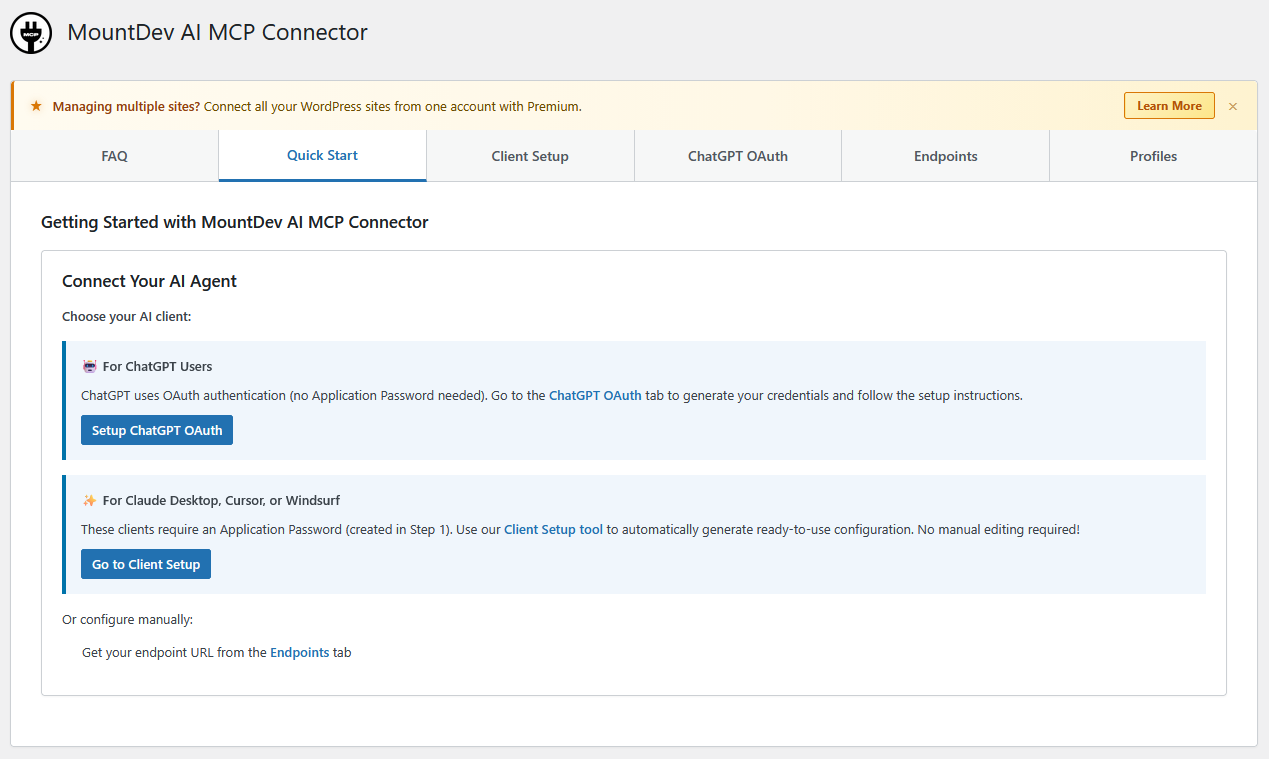
Quick start 
OAuth setup 
Profiles tab 
Endpoints tab 
Client setup tab 
FAQ tab
Ìgbéwọlẹ̀
- Upload the
mountdev-ai-mcp-connectorfolder to/wp-content/plugins/ - Activate the plugin through the ‘Plugins’ menu in WordPress
- Go to MountDev AI MCP Connector Quick Start to configure
For ChatGPT Users
- Navigate to MountDev AI MCP Connector ChatGPT OAuth tab
- Click Generate OAuth Credentials
- Copy the Client ID and Client Secret (keep them secure!)
- In ChatGPT, go to Settings Apps Create App
- Enter your MCP Server URL:
https://yoursite.com/wp-json/mountdev-ai-mcp-connector/v1/messages - Select OAuth authentication
- Paste your Client ID and Client Secret
- Authorize access when redirected to WordPress
For Claude Desktop / Cursor / Windsurf Users
- Create an Application Password in Users Profile
- Go to Settings MCP Connector Profiles and select a profile
- Use the Client Setup tab to automatically generate your configuration
- Or manually use endpoint:
https://yoursite.com/wp-json/mountdev-ai-mcp-connector/v1/messages - Authenticate with your WordPress username and Application Password
FAQ
-
What is MCP?
-
Model Context Protocol (MCP) is an open protocol developed by Anthropic that standardizes how AI assistants connect to external data sources and tools.
-
Is OAuth 2.0 secure?
-
Yes, we implement OAuth 2.0 with PKCE (Proof Key for Code Exchange) for enhanced security. All tokens have expiration times and refresh token rotation.
-
Do I need an API key?
-
For ChatGPT, generate OAuth credentials in the plugin admin. For other clients, use WordPress Application Passwords.
-
How do I set up ChatGPT?
-
Generate OAuth credentials in MountDev AI MCP Connector ChatGPT OAuth tab, then add the MCP server in ChatGPT settings with your Client ID and Secret. See Installation section for detailed steps.
-
Are my OAuth credentials secure?
-
Yes. Client secrets are encrypted using AES-256-CBC encryption before storage. Only WordPress administrators can generate or view credentials.
Àwọn àgbéyẹ̀wò
Kò sí àwọn àgbéyẹ̀wò fún plugin yìí.
Àwọn Olùkópa & Olùgbéejáde
“MountDev AI MCP Connector” jẹ́ ètò ìṣàmúlò orísun ṣíṣí sílẹ̀. Àwọn ènìyàn wọ̀nyí ti ṣe ìkópa sí plugin yìí.
Àwọn Olùkópa
Túmọ̀ “MountDev AI MCP Connector” sí èdè rẹ.
Ṣe o nífẹ̀ẹ́ sí ìdàgbàsókè?
Ṣàwárí koodu, ṣàyẹ̀wò ibi ìpamọ́ SVN, tàbí ṣe àgbékalẹ̀ sí àkọsílẹ̀ ìdàgbàsókè nípasẹ̀ RSS.