
Àpèjúwe
This meta-plugin allows regular plugins to specify other plugins that they depend upon.
Example:
/*
Plugin Name: BuddyPress Debug
Depends: BuddyPress, Debug Bar
*/
What this does:
- Disables activation of BuddyPress Debug until both BuddyPress and Debug Bar are already activated.
- When either BuddyPress or Debug Bar are deactivated, BuddyPress Debug will also be deactivated.
= Enriching dependency information =
Unfortunately, very few plugins currently contain dependency information. If youÌtumọ̀ Yorùbá: ’d like to enhance the information available to this plugin, you might want to install the Known Plugin Dependencies plugin which acts as an add-on to this one.
Links: Plugin News | AuthorÌtumọ̀ Yorùbá: ’s Site
Development of this plugin is done on GitHub. Pull requests welcome. Please see issues reported there before going to the plugin forum.
Àwọn àwòrán ìbòjú

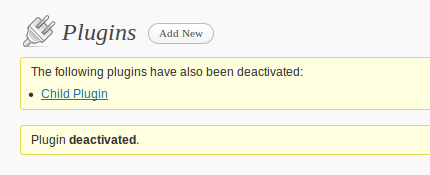
FAQ
- Error on activation: “Parse error: syntax error, unexpected…”
Make sure your host is running PHP 5. The only foolproof way to do this is to add this line to wp-config.php (after the opening
<?phptag):var_dump(PHP_VERSION);- What happens if a user doesnÌtumọ̀ Yorùbá: ’t have Plugin Dependencies installed?
Nothing. The Depends: header will simply be ignored.
- Can I have grand-child plugins?
Yes, the dependency chain can go as deep as you want.
- Defining virtual packages
Say you have some useful functions that you would like to package up as a library plugin:
/*
Plugin Name: Facebook Lib
Provides: lib-facebook
*/
Now, dependant plugins can specify ‘lib-facebook’ as a dependency:
/*
Plugin Name: Cool Facebook Plugin
Depends: lib-facebook
*/
Besides being more robust, the Provides: header allows multiple plugins to implement the same set of functionality and be used interchangeably.
Àwọn àgbéyẹ̀wò


Àwọn Olùkópa & Olùgbéejáde
“Plugin Dependencies” jẹ́ ètò ìṣàmúlò orísun ṣíṣí sílẹ̀. Àwọn ènìyàn wọ̀nyí ti ṣe ìkópa sí plugin yìí.
Àwọn Olùkópa


Túmọ̀ “Plugin Dependencies” sí èdè rẹ.
Ṣe o nífẹ̀ẹ́ sí ìdàgbàsókè?
Ṣàwárí koodu, ṣàyẹ̀wò ibi ìpamọ́ SVN, tàbí ṣe àgbékalẹ̀ sí àkọsílẹ̀ ìdàgbàsókè nípasẹ̀ RSS.
Àkọsílẹ̀ àwọn àyípadà
1.3
-
Add Dependency Loader class. Props kucrut.
-
Make it work with bulk actions. Props jrf.
- Usability: Remove bulk action checkboxes for plugins with unsatisfied dependencies on single site plugins page within a network. Props jrf.
-
Guard dependencies even when a plugin is (de)activated outside of the plugins page context. Props jrf.
-
Fix compatibility with multi-site. Props jrf.
- New: Show dependencies in the network admin plugins page.
- Bug fix: network activated plugins were not recognized (at all) and deactivating one would throw PHP notices.
- Bug fix: network activation action was not correctly unset if dependencies were not met (WP 3.4+).
- Bug fix: network deactivation would only check dependencies for the network and the main site, not for the other sites in the network
- Improved: logic for recognizing whether dependencies have been satisfied.
- Usability: On single site plugin page in a multisite network: added a “network” textual indicator for dependencies which were met by a network activated plugin.
- Usability: On single site plugin page in a multisite network: the required plugin names now only link to the plugin if the current user can activate that plugin.
- Usability: Improved information to single site admins when dependent plugins have been deactivated because a required plugin has been network deactivated Ìtumọ̀ Yorùbá: – show all deactivated plugins since last admin login, not just what happened in the last change round.
- Usability: Notifications about deactivated plugins are now shown on any admin page which will help admins notice changes made by this plugin earlier in case of a network deactivation. Props jrf.
- Improve style of plugin dependency notices. Props jrf.
- Usability: Add plugins deactivated by this plugin to the ‘recently active’ plugins list. Props jrf.
- Add Dutch translation. Props jrf.
1.2.1
- fixed notices. props cfoellmann
1.2
- added ability to use plugin names as dependencies
- more info
1.1
- added ‘Provides:’ header
- replaced ‘Dependencies:’ with ‘Depends:’
- more info
1.0.1
- fixed critical bug when not running MultiSite
- better network activation handling
1.0
- initial release
- more info